222 Field Squadron, RE, TA
Duke of York's HQ, Chelsea, 1958 - 1967

On PCs/Laptops page may look too large.
Reduce with "Ctrl" & "minus" or
click "View" then "Zoom out"
Created 05/2011, last edited: 17/10/26, 09:12
Reduce with "Ctrl" & "minus" or
click "View" then "Zoom out"
Created 05/2011, last edited: 17/10/26, 09:12

Home Page - Introduction
Were you a TA Sapper at the Duke of Yorks HQ in Chelsea in 1960-67 ? If you were, some of the pages on this web site may bring back some memories of those times. I'm Peter Cox, and the first seven years of my 24 years in the "Terriers" was in 222 Field Squadron during that time.
In 2012, twenty eight years on from my last TA pay-day, I launched this unofficial website to share photos, images, memories and news (past & present) with anyone that knew me or who served in the same unit. Many of the photos here I borrowed many years ago from my friend Ernie Davis who served in 222 for much of the time I did. We lost touch, and I have felt guilty ever since for not returning them (sorry, Ernie).
But I have made good use of them, many are displayed here and credited to you.
WEBSITE POLICY
No pop-ups, no adverts.
No registration, no log-in.
No personal details taken.
No pop-ups, no adverts.
No registration, no log-in.
No personal details taken.
COOKIES
There may be some cookies installed by search engines etc. Disable cookies if you wish, it will not restrict use of the site.
This site is currently (Oct 2026) still more like a personal blog, but I have tried to expand it into something much wider than that, and to extend the content into
earlier years. I would love to hear from any other ex-Chelsea Sappers and would appreciate contributions - news, photos, stories, recollections, messages, comments, ideas, praise, even criticism. All sources will be acknowledged. There may be some cookies installed by search engines etc. Disable cookies if you wish, it will not restrict use of the site.
My contact details are at bottom right.
Scroll down to read the sqn's history and photos of some of the volunteers, or choose a section to jump to from the menu.
Brief history of 222 Fld Sqn
and 101st (London) Engr Regt
222 was one of four sqns in 101. The Regimental HQ and two sqns, 222 Fd Sqn and 223 Fd Park Sqn, were based in the glorious settings of The Duke of Yorks Headquarters in Kings Road, Chelsea, London SW3. Another squadron, 220 Fd Sqn was at Heston, and the other, 221 Fd Sqn, at Peckham.
The regiment's history went back over 100 years, to 1860 and the 1st Middlesex Engineer Volunteer Corps formed by the McLeod of McLeod. To mark the centenary, the Regiment took advantage of its Annual Camp in Scotland in 1963 to send a party of senior officers of the Regiment to visit the then head of the McLeod Clan, Dame Flora, who marked the occasion, or the centenary, by allowing a small square of specially woven McLeod tartan to be worn on the left sleeve of our battledress.
The whole regiment was disbanded in April 1967 folowing the Governmemt's Defence Review of 1966, which resulted in huge cuts in the Army's budget, the reorganisation of the TA into a new force, the TAVR, and the disbanding of many units.
If you can add to or correct any of the above, please contact me.
November 2013 update: A new website has been launched for the Regimental Association of 101 (City of London) Engineer Regiment which promises to have more history of its predecessor regiment in the 1946-67 period. Links to that and many other TA and RE websites at bottom left
Significant events 1958-1967
| year | month | event | place | remarks | ref |
| 1958 | July-Aug | Annual Camp | Weymouth (Wyke Regis) | Enlarging RN sports field (?) at Portland Sun 3rd Aug USS Nautilus at Portland A "potential sapper" aged just under 16, attended as Officers Mess waiter. | 1 2 1 |
| 1959 | |||||
| 1960 | Annual Camp | Ripon (Ure Bank camp) | complaints of food led to sit-in in Dining hall on third (?) day due to all (?) meals being mashed potato & grated cheese | 3 | |
| 1961 ? | Annual Camp | Weymouth (Wyke Regis) | |||
| 1962 ? | Annual Camp | Penhale | |||
| 1963 | TA Driving Championship | 101 Regt team (by 222 sqn) 14th in ¼-ton class | 5 | ||
| 1963 | Annual Camp | Stirling | Floating bridge at Loch Venachar. Demolitions at Loch Sunart. Regt Offrs visit Dame Flora McLeod at Dunvegan Castle, Isle of Skye. | 7 | |
| 1964 | Courage Trophy | Maidstone to Chelsea | 222 Sqn team 3rd out of 50 | 6 | |
| 1964 ? | Annual Camp | Halton Nr Lancaster) | Trp task (?) aerial crossing over River Ribble. River flooded stranding troop. Radio relay at Morecombe Bay | 4 | |
| 1965 ? | Annual Camp | Germany (Hameln) | bridging on Weser/Weiser. | 8 | |
| Freedom of Boro' of Chelsea | Chelsea | Regt/Sqn marched through Chelsea with fixed bayonets | |||
| 1966 | April | Courage Trophy | 222 Sqn team 7th out of 26 | 9 | |
| 1966 | Annual Camp | Penhale (nr Newquay) | 12 | ||
| 1967 | April | DISBANDED | TA became TAVR and much reduced. | 11 |
| ref | source |
| 12 | Antony Green, e-mail Mar 2014 |
At Duke of York's HQ, Chelsea
I very much enjoyed my time at Chelsea. My first visit was when I was 14, exploring the garages on Sundays while my much-older brother, a Sgt, entertained my Dad in the Sgt's mess. I was soon taken on as a waiter in the Officer's mess on weekly drill nights, and for the occasional weekend dances, all of which I biked to.
One Sunday I went out in the back of an army "3-tonner" on "driver-training". I sat in the back with four of five trainees who took it in turn to have a half-hour lesson. At one point near Wimbeldon Common, the truck jerked badly and stopped. The trainee came to the back and climbed in. He told me it was my turn! I knew the instructor, and said I was surprised to be allowed to drive, I'd only driven farm tractors before. He said you can't be worse than [previous trainee] . I drove it all the way back to Chelsea.
I enlisted as soon as I was old enough. Apart from the occasions when we worked or trained strictly in our particular troops, such as at Annual Camps, much of the time we mixed together.
A motley weekend vehicle maintenance crew at Chelsea, 1960s.

Left to right: Billy Orford, George Spain (at back), Roy Miles, Peter Cox & Derek Spain (at back), with "Roy's" Austin Champ.
photo courtesy L/Cpl Ernie Davis
Army 'witticisms'
I very soon became aware of military "humour".
THE STORES at Chelsea
A new recruits tale:
"After completing my enlistment form & swearing aliegance to Queen & Country, I was sent to 'The Stores' to collect my uniform & equipment.
It was a large low-ceilinged windowless room with a long counter behind which were two men, and rows of metal racks containing an amazing stock. I said I'd come for a uniform.
"What size?" one asked.
I said I didn't know.
"doesn't matter, we've only got two sizes."
I fell into the trap, "what are they?"
"Too big and too small"
They roared with laughter, then the other asked
"Which do you want?
A new recruits tale:
"After completing my enlistment form & swearing aliegance to Queen & Country, I was sent to 'The Stores' to collect my uniform & equipment.
It was a large low-ceilinged windowless room with a long counter behind which were two men, and rows of metal racks containing an amazing stock. I said I'd come for a uniform.
"What size?" one asked.
I said I didn't know.
"doesn't matter, we've only got two sizes."
I fell into the trap, "what are they?"
"Too big and too small"
They roared with laughter, then the other asked
"Which do you want?
The one above is of course a classic. There were others. If anyone grumbled or complained, an NCO would say "its all a question of mind over matter. We don't mind, and you don't matter."
The first time is quite funny, but it gets a bit boring after a while.
Annual Camp 1958, Wyke Regis, Weymouth
I spent three weeks here as a 15-year old Officer's mess waiter cum dogsbody after I'd left school. I had lots of time off, and wandered around the camp and countryside sometimes getting lifts on an army truck,but mostly walking.I came here again in 1961, that time in uniform
Annual Camp 1960, Ure Bank, Rippon
Rippon had several military sites. In the city, Deverell and Claro barracks, and Laver Bank (centre left on map). It was the home of the Bailey Bridge, designed there in mid 1941, prototypes tested within months, mass production begun soon after, and first deployed in action in Italy by the end of the Year.
Ure Bank was an RE bridging training site in a curve of the River Ure, north of North Bridge, away from the other sites (centre right on map).
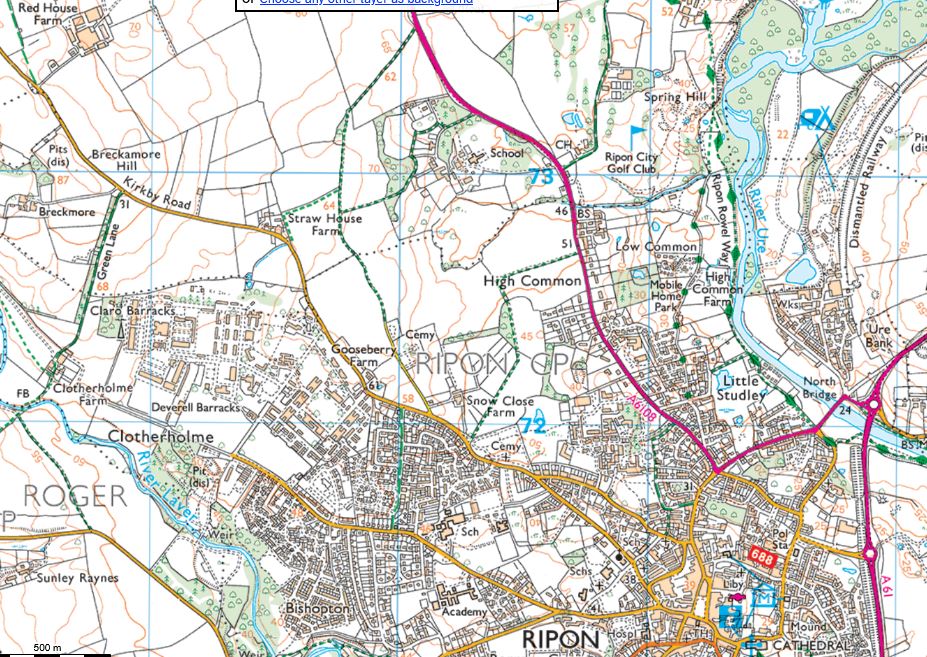
It was my first camp in uniform, and I found most aspects baffling. Updating this page in late 2026, I'm not sure whether we were based there, or at Deverell barracks and trucked to and from. I recall accomodation, wherever located, was in the usual wooden buildings found in many military camps and probably built during WW2.
What I do remember with great clarity is the food. On the third of fourth day of mashed potatoes seemingly for each meal every day, we sappers went on strike. We sat in the canteen banging our mess tins with spoons chanting better food or no work. The riot act was read to us, but we wouldn't move. We were assured the mash contained cheese and other items. We were not convinced. Eventually we were promised improvements and left the canteen.
When I first wrote this webpage back in 2011, I understood that by the 1980s the army had vacated, the buildings demolished, and the site used as for static caravans.
But other reports said the camp was still in use by cadets forces, and others wanting some adventrous activities.
I was a member of 3 troop:
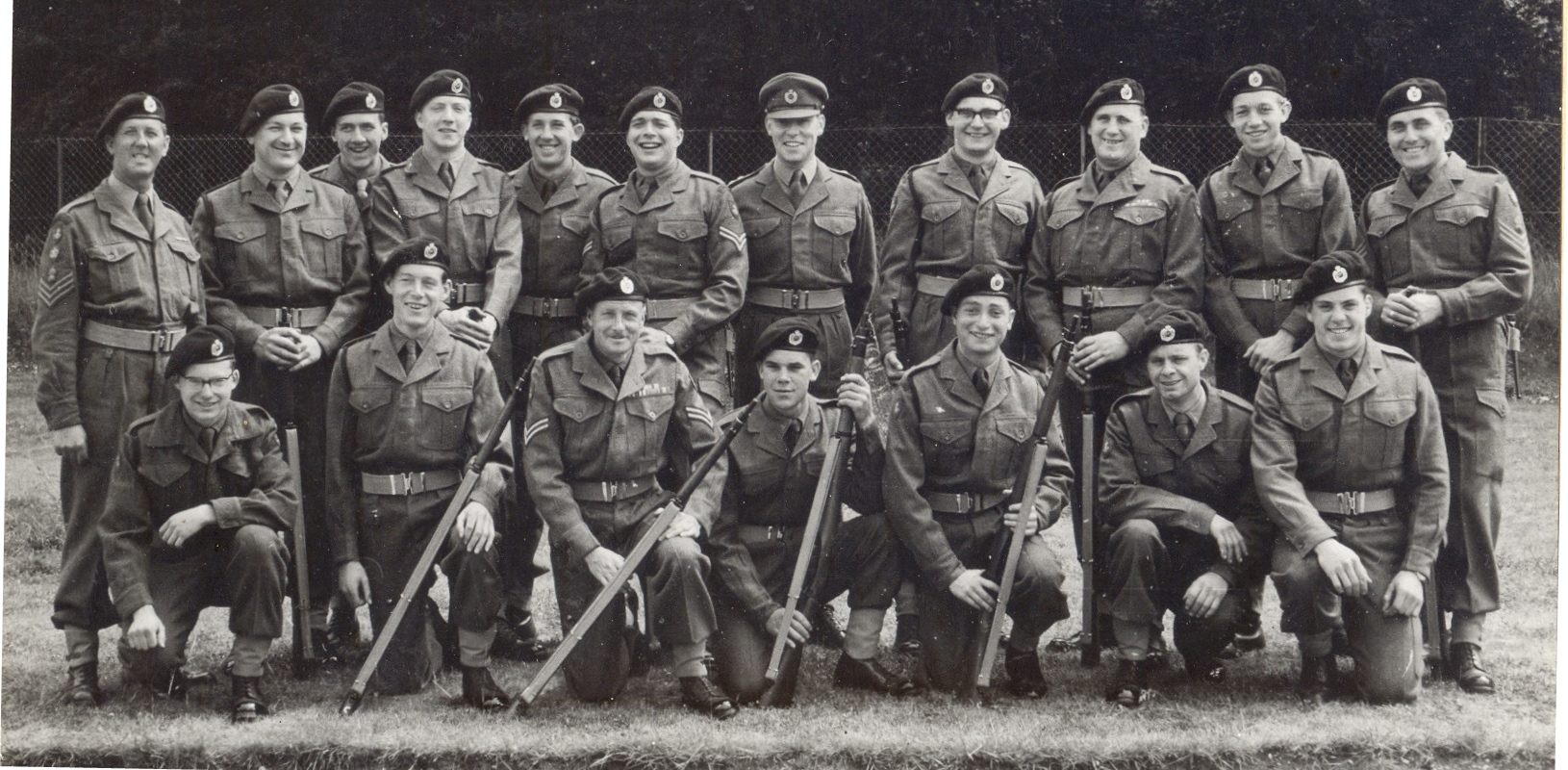 from left to right:
Rear: S/Sgt Eric Aldenton, Cpl Parr, Spr Ernie Davies, Spr Terry Beckwith, ?,Cpl Tepper, Lt Fordyce, Spr John Thomas, Spr ?, Spr ?, Sgt Walker.
Front: Spr Peter Cox, Spr ?, Cpl Fred Billington, Spr ?, Spr Finn/Flynn, Spr ?, Spr ?.
?
Something I disliked was "square bashing" - being marched about. (My brother quite the opposite, loved it.) Nearly half the troop were in "The drill team", who competed annually with other three troops. Luckily, I wasn't good to be selected.
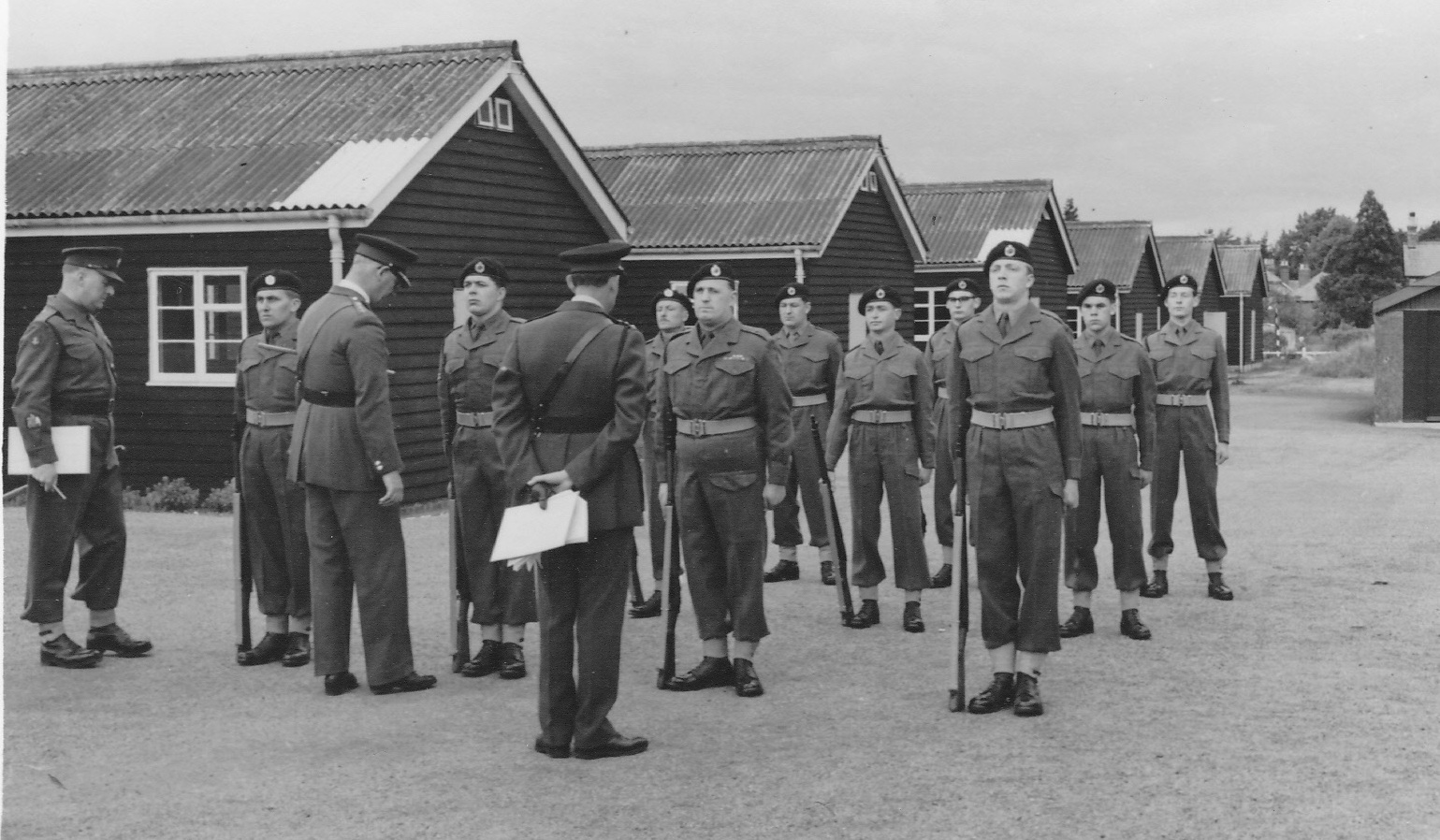
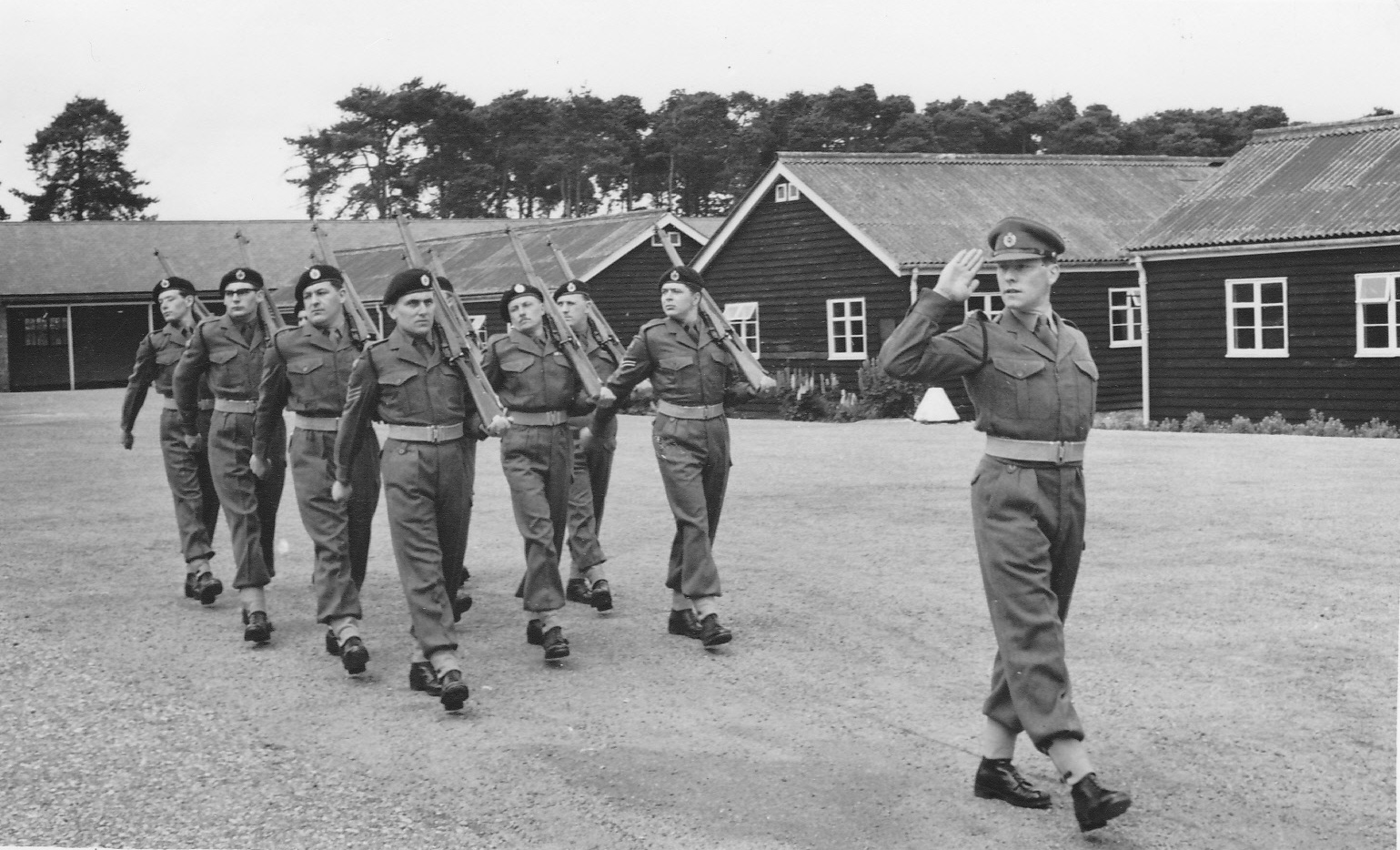
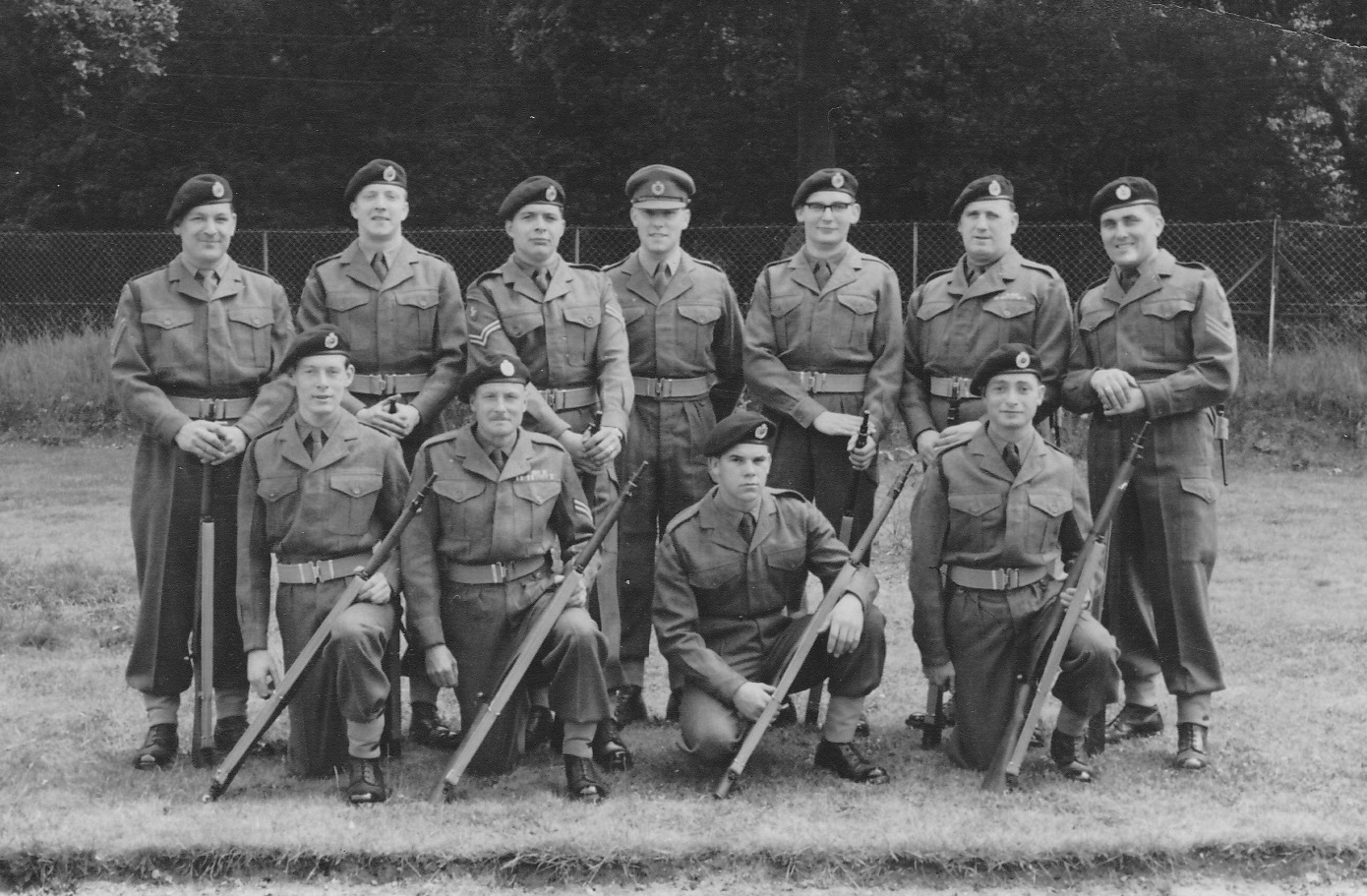
The 11-man drill team.
photos ?
Annual Camp 1961 - Wyke Regis (Weymouth)
Wyke was a bridging camp, on the side of the Fleet, the tidal lagoon between Chesil Beach and the mainland. The camp is at the narrowest part where the tide from Portland harbour runs fastest, in and out, providing a very challenging site for building floating bridges.
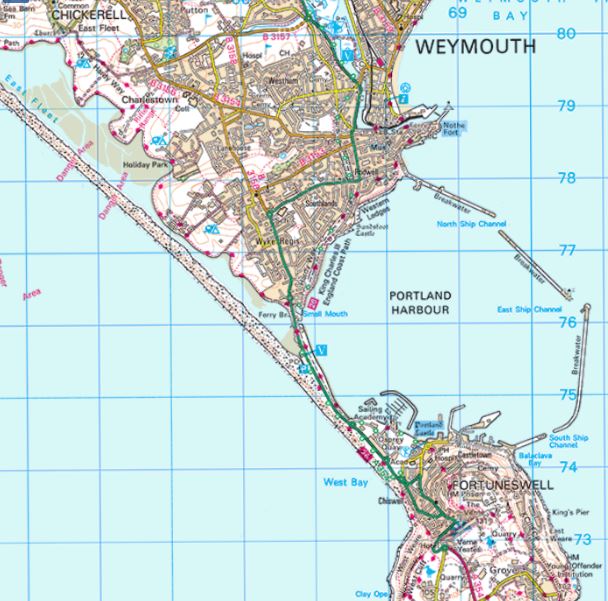
OS Leisure map 1/50k or 1/25k via National Library of Scotland
Also challenging living in the 6-man tents up on the hillside above the bridging "hard" i.e hardstanding. (below). The messes were hutted, also some stores.
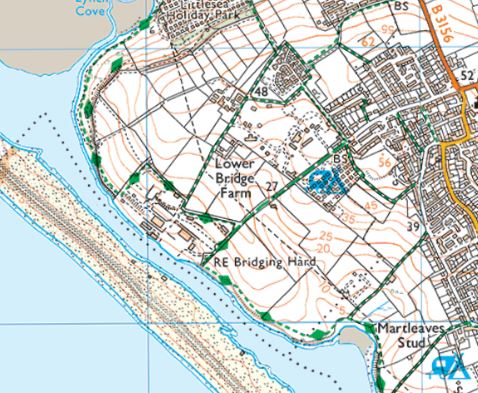
Nearby Chickerell Camp was hutted and had a rifle range where we took our annual test firing our 303 Lee-Enfield rifles.
But not dressed like this!

Left to right:
standing: Terry Beckwith (became a fireman and had to leave the TA), Don't know, Don't know, Duncan (head only), "Chanells" Can't remember, David Grey, Sgt Cliff Saint, Don't know.
front: Can't remember, Micky? Finn/Flynn, Peter Cox, John Thomas, Mick Byrne and Bert Butler (MT Cpl and my driving "instructor").

Standing, left to right: Peter Cox, Ernie Davies, ?, David Gray, Mick Byrne. In front, Ted Allen. (all Sprs)
David was, or went on to be, a civil engineer. Later a Cpl, then commisioned but stayed in 222 Sqn, and we remained good friends until the unit was disbanded and we went our separate ways.
Time off on Portland. Holding-up one of the old railway bridges.

Top: Peter Cox: Middle left, Mick Byrne, right John Williams; Bottom left Harry Sheldrake, center, Mick Bligh.
Mick Bligh spent much of his early life in Canada, returning to the UK in his mid-teens and later becoming a London ambulance driver.
One way of passing spare time at Weymouth waiting for parade, lunch, etc. was "baiting" Capt. Craddock-Jones. He was a portly offcer with a saluting action that most of the junior ranks found very amusing.
One of his duties seemed to be looking for litter, and when spotted heading towards a group of buildings to do an inspection, a small group of young sappers would gather in front of the nearest hut.
As "Haddock-Bones" approached they would come to attention, and one would salute. In return "H-B" would lean back from the waist, push his stomach out, and begin his salute.
His action was impeccable in most respects, albeit rather slow. But when his hand reached his forehead, the upper part of his arm quivered for several seconds, with his hand bouncing on and off his head several inches. This went on in decreasing amouts until eventually the arm was motionless, and he could lower it.
The whole thing could take him a dozen or so paces to complete, by which time he was often well past the group and beginning to go down the far side of the hut. The group would then rush round the other way to the back, and be waiting to repeat the game. That usually finished litter inspection for the day.
Some of 222's other "characters".
DUNCAN
well-built, ex London Scottish, nice baritone voice led sing-songs in many otherwise quiet pubs that we over-ran at weekends or camp, but just a little short of a sense of humour.
"CHANNELS"
irrespressible, great fun, owned about a dozen firearms, played boogie-woogie on the piano, allways an entertainer.
Came to Chelsea to join-up wearing a bowler-hat & carrying a rolled umbrella looking every inch a gent. Asked the first person he saw - Duncan - to take him to the OC. Duncan came to attention and with "good evening sir, certainly sir, this way sir", led him upstairs. Duncan was very miffed the next week to see a new Sapper in the ranks.
Got his nick-name after being told by the SSM that if he wanted something, he shouldn't go to the OC, but must use the "right channels"
DUNCAN
well-built, ex London Scottish, nice baritone voice led sing-songs in many otherwise quiet pubs that we over-ran at weekends or camp, but just a little short of a sense of humour.
"CHANNELS"
irrespressible, great fun, owned about a dozen firearms, played boogie-woogie on the piano, allways an entertainer.
Came to Chelsea to join-up wearing a bowler-hat & carrying a rolled umbrella looking every inch a gent. Asked the first person he saw - Duncan - to take him to the OC. Duncan came to attention and with "good evening sir, certainly sir, this way sir", led him upstairs. Duncan was very miffed the next week to see a new Sapper in the ranks.
Got his nick-name after being told by the SSM that if he wanted something, he shouldn't go to the OC, but must use the "right channels"
AND FINALLY
After one Morning Parade at Wyke/Chickerell, the SSM, WO2 George Walker, made various announcements, finishing with
"lastly, will whoever crapped last night on the steps to the Officer's Mess, please call at the Sqn office to collect his belt and false teeth."
His command to "fall out" was barely audible over the laughter.
After one Morning Parade at Wyke/Chickerell, the SSM, WO2 George Walker, made various announcements, finishing with
"lastly, will whoever crapped last night on the steps to the Officer's Mess, please call at the Sqn office to collect his belt and false teeth."
His command to "fall out" was barely audible over the laughter.
Annual Camp 1962 - Penhale Camp, nr Newquay
The webmaster recalls going to Penhale Camp twice and the very long tiring convoy drives (I would have driven a "3-tonner" a Fordson truck or Commer tipper). Also the fantastic night-life in Newquay - but little else!It was established in 1939 when the MOD (Ministry of Defence) took over nearly 1,000 acres of the coastal area south of Newquay in Cornwall. The camp itself covered only abut 40 acres atop the cliffs overlooking the sea immediately to the west of Holywell Bay. To the south, a further 948 acres of mostly grassland and sand dunes, some over 200 feet high, became the range and training area.
 source:
It was used during WW2 as an anti-aircraft training camp by Allied forces including Americans engineers who built a number of nissen huts. After the war it continued to be used as a training camp by the army including TA/TAVR units for their annual summer camps.
By the 2000s, the camp comprised about 650 bed spaces in numerous single storey buildings and was used by some 10,000 personnel annually from regular and reserve units, and also by Cadets.
However by 2010 the camp was surplus to requirements and the MOD sold it by auction.
However in 2023 it seems to serve a "campiing" service, most of the buildings seem to have survived (source: Google street scene), and little or nothing added.
One report said that Ligger House the grade 2 listed 19thC mine count house building SW of the camp would not be sold, but an MOD report of the sale said the house was included. The training area was retained by MOD.
There still remains evidence to the north of the camp of the WW2 gun sites, searchlight batteries and defensive positions such as pillboxes and trenches.
This was once a mining area, and there is also evidence of several disused mineshafts north of the camp, and south in the training area.
area road map
source:

camp and training area
source: South-West Coast Path Association

satellite view of camp
source: google

aerial view of camp
source: unknown

aerial view of coast
source: www.eboadventure.co.uk

camp entrance c1960
source: Frances Frith Collection
view of camp c1960
source: Frances Frith Collection

Perran Beach c1960, Penhale Camp in far distance
source: Frances Frith Collection
camp entrance gate 2008
source: Pierre Terre, www.geograph.org
view of camp
source: geograph.org.uk

camp c2008
source: www.geograph.org
Annual Camp 1963, Stirling, Scotland
Major events
- Bridging in the Trossachs, Floating bridge at Loch Venachar
- Demolitions at Glencripesdale
- Regt Offrs visit Dame Flora McLeod at Dunvegan Castle, Isle of Skye
The webmaster was a civilian-employee at 101 RHQ at Chelsea at the time and was part of the advance party, driving RHQ's stores truck, a Bedford OL 4x2 3-tonner on the very long journey to Stirling Castle one wet day and night.
The truck was of crude design,
 with just one dipped beam headlight, tiny mirrors, and a single windscreen wiper which stopped working half way there, entailing an arm out of the window with a bit of rag to wipe off the rain for many hours in the dark.
The return was more pleasant,
 on a sunny day driving an even older truck, a 3-tonner signals truck, a Bedford QL 4x4 with its familiar whistling exhaust sound. This may have been borrowed for camp, as the webmaster cannot recall it being part of RHQ's normal allocation. But it was 50 years ago.
In between these journeys he
was a L/Cpl in 222 Sqn, driving 3-troop's 3-tonner, a Fordson 4x4, and much enjoyed driving around the Trossachs and later the challenge of Glencripesdale.Bridging in the Trossachs
The first week of the Squadron's annual camp in Scotland was spent building pontoon rafts and/or a floating bridge at Loch Venachar, in the Trossachs. The "Light Assault Raft" (LAR) and "Light Assault Floating Bridge"(LAFB) are built from the same kit of parts.
Below is a raft with 4 pontoons close coupled, landing ramps each end (this end grounded) and a couple of outboard motors ready to be fitted. This is probably on the south bank of the loch.

photo courtesy L/Cpl Ernie Davis, 1963
This is another shot of the raft with the OC's Land Rover aboard (note jerry can of fuel for the motors seen just beyond the right leg of the man with his back to the camera).

photo courtesy L/Cpl Ernie Davis, 1963
Next is taken presumably from the raft, more pontoons can be seen coupled together in the water on the other side. So was that another raft or was this a floating bridge being built from each side?

photo courtesy L/Cpl Ernie Davis, 1963
This shows WO11 George Walker, the very popular SSM, holding a breastline attached to a pontoon, and Spr Colin Steele easily recognisable even with only half a head showing as he was 6ft 7ins tall, the tallest man in the squadron. He had been sent out into the cold water of the loch to free some obstruction, hence his wet denim trousers.

photo courtesy L/Cpl Ernie Davis, 1963
The bridging equipment and pontoons were delivered by another TA unit (RASC ?) and unloaded somewhere along the south side of the loch, possibly around West Dullater. There, the pontoons would have been rigged at a pre-assembly area, then towed to to the launch site by some of 222's drivers.

photo: anon, ex-on-line

photo courtesy L/Cpl Ernie Davis, 1963

photo courtesy L/Cpl Ernie Davis, 1963
Demolitions at Glencripesdale
The second week of 222's camp in Scotland was to be a demolitions exercise in a very remote part of the west coast of Scotland. The "target" was a once grand mansion built of special concrete, but now rather derelict. The officers would have known a good deal more, but whatever they did know, they kept to themselves.
For the Squadron's drivers, the route from Stirling became more and more challenging and exciting as it progressed, and for some it was the best part of the week and long remembered. For passengers, even those in the back of a 3-tonner, the journey gave spectacular views of the rugged beauty of an area most had never seen.
From Stirling to Loch Tulla, north of Bridge of Orchy, the road ran alongside lochs and rivers with mountains rising up either side, then climbed to over 1,000 feet and across the bleak, boggy plateau of Rannoch Moor.
Next, the narrow Pass of Glen Coe (right lower centre)

between incredibly steep mountains rising above 3,000 feet; and down to the village of Glencoe on the south shore of Loch Leven. The Squadron decided not to cross the Loch via the Ballachulish ferry (this was long before the bridge) but take the long route around via Kinlochleven (the long narrow loch centre right above) to get to the narrowest part of Loch Linne (map below, upper centre).

The Corran Straits and Ballachulish
from the issued 1961 military OS 1" map
There they saw the ferry that was to take them across. It had a swivelling deck, and looked ridiculously small.

source: scan of old post card posted on Flickr by Neil F King in 2008
Here, looking west, its about to disembark four cars via one of the two tail-ramps. We doubted it would take our 3-tonners. Even if it could, it would be just one. It would need many journeys
It was five hundred yards to the other side, to a pier in front of an old inn, the Ardgour Hotel. The waters looked cold and choppy and to the left of the inn there was a lighthouse

Photo courtesy of L/Cpl Ernie Davis,1963
and beyond that a very wide arm of the sea. Altogether it was not a sight to fill the troops with much confidence of a safe voyage.
The OC and several other officers with their drivers and ¼-tonners (the OC had a Land-Rover, the rest Austin Champs) were first to go, and took shelter in the Inn to await the convoy. By the time the last truck was back on dryland, there were quite a few well lubricated officers and soldiers filling the Inn.

Ardgour Hotel and pier on the west bank.
Photo: John Allen 2007, Geograph
Below, from the ferry, looking back (east) to the Corran Inn and pier where the convoy embarked.

Photo courtesy of L/Cpl Ernie Davis,1963
Once re-assembled, the convoy set off again, travelling south on the A861. It was single track with occasional passing places and few could believe that such a road could be clasified as an "A" road. But then came the A884 along the south shore of Loch Sunart, not only a single track "A" road, but one with grass in the middle!
At Liddesdale the convoy turned onto a stony track and after 3 miles reached Laudale House. There the public right of way ended and the route was now via a rough Forestry Commission track cut into the hillside that flanked the loch. It was very narrow, often with a sheer drop down to the loch on the drivers side.
After eight miles of nerve-racking travel at walking pace, the convoy reached Glencripesdale - between and below the red 66 and 67 below.
 from the issued 1961 military OS 1" map
 They were not impressed, the building didn't quite live up to the "mansion" image, although it was quite large.

photo: Iain Thorber Collection
In fact it turned out to be Glencripesdale Farmhouse, a late 18th century Tackmen house just north of Glencripesdale Burn, and much lower and nearer the loch than the target.
But just a short distance away, they found the mansion.

an official photo, origin unknown

Safety shelter for the dems crew
Photo courtesy L/Cpl Ernie Davis,1963
It took two attempts and the best part of 1,000 lbs of plastic explosive (PE3) to demolish the remains, proof of the Victorian builders skill and the effectiveness of the materials used. But up she went!

Courtesy: photo: L/Cpl Ernie Davis,1963
Although the lead from the roof had long gone, lead from the internal drainpipes and lead plumbing were salvaged by some shrewd sappers and transported back to London and sold.

Jumping into the river from the bridge was only for the more daring squaddies.
Glencripesdale Part 2, 2011 - 2015
48 years after the demolition, I published an early edition of this webpage. I was amazed at the interest soon shown, regrettably not from ex-squaddies, but from people who had an interest or knowledge of the area. Bit by bit I learned so much more about the house and the family that had owned both; how it became derelict; and a planning application to build a new house on te siteGlencripesdale Estate, 35,000 acres of deer forest, grousemoor, some farmland and several large 'tackmens' houses, was bought in 1871 by the wealthy Newton brothers, 2 clergymen & a barrister from the English Midlands.
They planned a huge gothic mansion as a gentleman's retreat & sporting lodge, south of Glencripesdale Burn with another, smaller, burn nearby (presumably supplying water to the house) 100 feet above and 600 yards from Loch Sunart.
Built 1872-75 by W. Menzies of Oban, using lightweight concrete made from 20mm crushed rock without fine aggregates or sand to show that the new material could withstand the worst Scotttish weather and salty sea mists.
The 3-storey mansion is said to have had an observation tower, 5 public rooms, 28 bedrooms, 20 for family and guests, and 8 for servants (including some dormitories).

Glencripesdale House, 1880s
(from "The Western Seaboard" by Mary Miers, in my library)
Several other buildings were also built nearby to support a community of 100 during "the season", also a couple of bridges across Glencripesdale Burn.
One was the ornamental stone one that the more daring squaddies jumped from in 1963.
There was also a stone/concrete jetty into the loch which provided the only access. The squaddies also used that to launch an outboard-motored assault boat to visit an inn on the far bank for evening drinks.
During WW2 (1944?) the house was requisitioned as a commando training base, & apparently vandalised. After the war the Newton family were disillusioned by its condition, and sold it in 1948, to someone who then did far worse than the commandos - stripping the lead from the roof (selling it for more than he paid for the house) and letting it become derelict.
The estate was bought in 1955 by the Forrestry Commission, who asked the army to demolish the remains - hence 222 Field Squadron's demolitions exercise of 1963.
Left, the Farmhouse as it was then; right, in 2008 with conservatory added

photo by Gordon Brown, 2008
In 2012, after a 7 year planning battle, a planning application was finally granted for anew 6 bedroom house on the mansion site (the main objector being the owner of the old farmhouse which had been purchased with a small plot of land in the 1980s.) After receiving permission, the owners put the whole estate up for sale.
In June 2012 I was e-mailed by Edward Towers:
"I was interested to see your website! This is my old family estate, my great, great, grandfather Rev Horace Newton built Glencripesdale Castle in 1871. We still have the Isle of Carna, I was at Glencripesdale walking on the ruins only last week!"Oh, the power and glory of the internet! Edward kindly sent me some photos of the mansion/castle in its heyday and the rather tongue in cheek poster

poster courtesy of Edward Towers
at the start of this section advertsing its pending demise, printed by another TA sapper unit, 338 Cartographic Sqn.

Glencripesdale Mansion/Castle in its glory
photo courtesy of Edward Towers
Glencripesdale and Carna from a 1961 military OS 1" map
Visit to Dame Flora MacLeod, 1963
101st (London) Engr Regiment's history went back to 1860 when the 1st Middlesex Engineer Volunteer Corps was formed by the McLeod of McLeod. In 1963 a group of senior officers from 101 visited the then head of the McLeod Clan, Dame Flora MacLeod of MacLeod, DBE, at her home, the 800 year old family seat, Dunvegan Castle on the Isle of Skye.
Dame Flora was born in Downing Street, London, in 1878, at the home of her grandfather Sir Stafford Northcote the then Chancellor of the Exchequer. When her father, Sir Reginald MacLeod, became chief of the Clan MacLeod in 1929, she was elected President of the clan's society and went to live with her father at Dunvegan, later suceeding him as Chief of the Clan, in 1935. She was created a DBE in 1953 and lived at Dunvegan Castle until 1973, three years before her death.
To mark the centenary
 of the founding of the Regiment, a special tartan was woven from which 2-inch square pieces were issued to all members of
the regt to be worn on the top of the sleeve on one arm of the battledress.
of the founding of the Regiment, a special tartan was woven from which 2-inch square pieces were issued to all members of
the regt to be worn on the top of the sleeve on one arm of the battledress.The "Courage Trophy" (Tough Training Competition) 1964 and 1966
In 1961 a "Tough Training Competition" began for TA Units in London and became an annual event up to at least 1967 (the year the TA dissolved into a much reduced force, the TAVR; I don't know what happened subsequently). The format for these weekend events changed little then, with each team having a marching section and an administrative one. On the Saturday, the marcher's tackled a set-piece march with obstacles or tests en-route while admin were tested in driving, cooking and setting up a camp; the sections joined for an evening meal and some rest followed by a night compass march - and eventually some sleep. Sunday involved running & shooting, an assault course, navigation and military skills and finally a forced march to the finishing point. It was very challenging and tiring - at all times we were in (near) 'full battle order' - packs, pouches & rifle (the first two loaded, but not the latter) even over the assault course.
In 1964 the Courage Brewery, based near Tower Bridge, sponsored the event and donated a trophy for the winners, and the competition was re-named "The Courage Trophy". That year the Squadron decided to enter, and I put my hand up. We practiced forced marching on a number of weekends, and were fairly confident we could deal with that, but we had very limited opportunity to learn the other skills. (Bear in mind our normal training was bridge building, demolitions and driving.)
Fifty teams started, from units in London, the Home Counties and East Anglian District, making it the most competitive so far. It started at Maidstone with a 12 mile march with a number of obstacles, all to be completed in 3 hours, which we did. In fact our progress over the whole weekend was pretty good, except for the shooting. Running a hundred yards cross country in full gear, then still puffing & panting having to kneel or lay down, aim & fire at a pop-up target, all repeated several times, was not easy and we lost a few points.
Sunday afternoon on the 'home straight' we were told we were doing well, and we marched into the finishing point, the Duke of York's HQ, our own TA Centre with our mates cheering us on, giving a lusty rendering of the chorus of the number 1 pop song of the day (recorded by the Dave Clarke Five) modifying the lyrics slightly to "we're feeling glad it's all over".
To our enormous delight, and the surprise of everyone, we achieved third place, an extraordinary result for a 'corps' unit. My memory tells me that the team placed 4th, a para one I think, were so annoyed at being beaten by sappers (and our taunts that we normally did all this carrying bailey bridge panels) that they demanded a review of the scores. By the time the original results were confirmed the presentation ceremony had ended and we didn't get our moment of glory in front of the crowds, army big-wigs & various VIPs. But later we did get an engraved pewter mug, and ever since I've used it at Christmas to remind myself that in spite of often being called a bolshy, cocky little sod, I was actually quite an efficient soldier.
This is the very proud 1964 team.

Clockwise from left: Colin Steele (6ft 6½, the tallest in the Sqn), sory can't remember, Mick Byrne (about 5' 6" and not much more than 9 stone), Ted Allen (about 5' 5"), David Gray, Lt. (JG?) Knott, Sgt George Spain (who always seemed unruffled), Roy Miles, "Sam" Olerujara(?) (a Nigerian with unpronouceable names, didn't say much but laughed a lot), and Peter Cox (5ft 6" and nearly 10 stone and presumably still awaiting his beer) (and now Webmaster of this site). Apart from George who looked about 40, we were all in our early 20s.
Note the old-fashioned thin denim blouse & trousers - we weren't issued with the smart warm modern stuff most of the other teams had.
As a reward for our efforts, Lt ("Mr") Knott arranged through his brother, a pilot in the Army Air Corps, for a weekend at the air base at Middle Wallop. The official reason was camouflage training and after doing our best to conceal our trucks in the woods we went aloft to see the effect, with flights in a 2-seater Saunders-Roe Skeeter helicopter and a 3-seater Auster trainer. When I went up in the Skeeter, the pilot dived the craft at 45 degrees until we were just above tree-top height then skimmed along parallel to the ground but still at the same angle - very, very scary. In the Auster I was lucky to be sitting next to the pilot (the other seat was behind us) and was allowed to take the controls for a while somewhere over Salisbury, I think. The camouflage wasn't very good, but the flying was terrific.
In April 1966 we again competed and came 7th (out of only 26), a rather dissapointing result as the team was mainly the '64 one, but nevertheless another fine performance for a non infantry unit. We would have done much better but for two factors. First, we lost marks for a late start on Sunday morning because none of us remembered the clocks would go forward an hour during the night (Lt. Knott was mortified!). Secondly, one of our team collapsed towards the end of the final march and for the last mile or so had to be supported between two others, with his pack & pouches carried by a third, and his rifle by a fourth (me) which enevitably slowed us down. Carrying an extra rifle was nothing compared with the burden of the other three, and if it hadn't been for them we wouldn't have finished as a team.

1966 - Congratulatory letter
Hameln (Hamlin) Germany, maybe 1964 or 65-ish (?)
Off duty from annual Camp at Hameln in Germany, enjoying a boat trip on the River Weiser.

Left to right: Ted Allen, Mick Bryne, ?, Frank Heaversedge, Peter Cox.
Frank was Rhodesian, and gained a degree in Engineering at Cape Town. He went back home just before or just after Ian Smith declared UDI in Nov 1965, and he wrote to me shortly afterwards suggesting I should emigrate there - I think he said I could join the police force! He and his wife now live in Shropshire.
Annual Camp 1966 - Penhale, nr Newquay
See Annual Camp 1962 for general photos and maps of Penhale training camp.

Rock breaking or drilling prior to laying explosives?
Mystery Section
Here are a selection of photos that I cannot place exactly. If you can help please contact me.
Points that may help. The truck is a Fordson 4x4 GS, the standard 3-tonner issued to most Troops in 222 Fd Sqn, and other Sqns in 101 Regt. It looks as though it has its winch rope attached to whatever is being inspece. The compressor is not the standard 2-wheel Pescara. Personnel are from at least 2 Sqns. On left is S/Sgt? George Orford of 222, the officer looks like Maj Parkin, OC of 222, 2nd from right is Sgt? Bob Shaw who was with 221 Sqn at Histon.

Spr? Peter Cox breaking or drilling rock
In Memoriam
WO2 George Orford, MBE
 George died at home in May 2013 aged 83. He had been suffering from cancer for time.
I believe he was conscripted into National Service in 1949, and afterwards posted as a reservist, later becoming a TA soldier, at 221 Fld Sqn RE at Peckham. In the early 60s I think, 221 was merged with 222 Field Sqn at the Duke of Yorks HQ in Chelsea where he eventually became SSM. In 1967 the whole of 101 Engr Regt, of which 222 was part, was disbanded. Two years later, a new RE Regt was formed with one squadron in London, 217 Fd Sqn at Holloway, which George happily joined from day one, becoming SSM.
George was a prominent member of the Peckham Branch of the REA and was Branch Secretary for many years until 2011.
Well over 100 mourners attended his funeral on 3rd June 2013 at Honor Oak Crematorium in South London. There were 16 or 17 ex-members of 217 present, but sadly only 3 from 222 days, (Col) Peter Williams, (ex-Cpl) Billy Orford (George's brother) and me (the webmaster) (ex-Cpl) Peter Cox.
I remember George with affection and great respect. A tall, bulky man of immense strength, yet could waltz around a dance floor on his toes with his wife Mary like a professional. He was firm but fair, always helpful.

above, the service card, below, the Crematorium and some of the mourners after the service


Cover of Funeral Service card
George died at home in May 2013 aged 83. He had been suffering from cancer for time.I believe he was conscripted into National Service in 1949, and afterwards posted as a reservist, later becoming a TA soldier, at 221 Fld Sqn RE at Peckham. In the early 60s I think, 221 was merged with 222 Field Sqn at the Duke of Yorks HQ in Chelsea where he eventually became SSM. In 1967 the whole of 101 Engr Regt, of which 222 was part, was disbanded. Two years later, a new RE Regt was formed with one squadron in London, 217 Fd Sqn at Holloway, which George happily joined from day one, becoming SSM.
George was a prominent member of the Peckham Branch of the REA and was Branch Secretary for many years until 2011.
Well over 100 mourners attended his funeral on 3rd June 2013 at Honor Oak Crematorium in South London. There were 16 or 17 ex-members of 217 present, but sadly only 3 from 222 days, (Col) Peter Williams, (ex-Cpl) Billy Orford (George's brother) and me (the webmaster) (ex-Cpl) Peter Cox.
I remember George with affection and great respect. A tall, bulky man of immense strength, yet could waltz around a dance floor on his toes with his wife Mary like a professional. He was firm but fair, always helpful.
above, the service card, below, the Crematorium and some of the mourners after the service
Cover of Funeral Service card
Contributors
ACKNOWLEDGEMENTS
Text: Peter Cox. Any comments, please e-mail me
For many of the photos of 222 Fd Sqn in the 1960s: Ernie Davis
Other photo & information sources as noted.
Copyright remains with the original source.
Text: Peter Cox. Any comments, please e-mail me
For many of the photos of 222 Fd Sqn in the 1960s: Ernie Davis
Other photo & information sources as noted.
Copyright remains with the original source.